
When you think about your car, you probably think about its engine, colour, or maybe the sound system. But what about the number plate? It might seem like a simple piece of plastic or metal, but it's governed by a surprisingly strict set of rules from the Driver and Vehicle Licensing Agency (DVLA).
These regulations aren't just bureaucratic red tape. They dictate the exact font, spacing, size, and materials for every number plate on UK roads. The goal is simple: absolute clarity. Your plate needs to be instantly readable by everyone, from a police officer at the roadside to the Automatic Number Plate Recognition (ANPR) cameras that monitor our motorways.
Think of your number plate as your vehicle's official fingerprint. To be legal, it has to be perfect.
Why Do We Even Need These DVLA Rules?
A number plate is far more than just a jumble of characters; it's a legal document bolted to your car. The whole point of the DVLA regulations is to create a totally uniform system, ensuring any vehicle can be identified quickly and without a shadow of a doubt. This isn't just for issuing parking tickets—it's a cornerstone of road safety and modern law enforcement.
Imagine trying to read a road sign written in ten different fonts, with random spacing and clashing colours. It would be a chaotic mess. The same logic applies to number plates. Standardisation is what makes the technology behind traffic management and policing work so effectively.
The Core Pillars of Compliance
The regulations are built on a few key pillars, each one playing a critical role in making a plate legal, legible, and durable. Let's break down what the DVLA is looking at.
- Character Font and Size: You can't just pick any font you like. The law mandates the use of the ‘Charles Wright’ font. Every character has a specific height, width, and even thickness.
- Spacing and Margins: This is a big one. The rules define the precise gap between each letter and number, as well as the space between the two main groups of characters. Even the margin around the edge of the plate is regulated.
- Materials and Reflectivity: Your plate must be made from a specific retroreflective material that bounces light back towards its source (like car headlights). This is all laid out in the British Standard BS AU 145e.
- Required Markings: A legally compliant plate has to show who made it. This includes the supplier's name and postcode, plus the British Standard number itself, usually in small print at the bottom.
Together, these elements ensure your registration mark is crystal clear, whether it's midday or midnight, raining or sunny, and from almost any angle.
Did you know the UK's number plate system has a surprisingly long history? It all started with the Motor Car Act 1903. The very first registration, "A1," was famously snapped up by Earl Russell in London. It wasn't until 1974 that the DVLA took over from local councils, creating the standardised national system we have today.
To help simplify what the DVLA requires, here’s a quick-glance table covering the fundamental rules.
Key DVLA Regulation Pillars at a Glance
| Regulatory Area | What It Covers | Why It's Important |
|---|---|---|
| Characters & Font | The specific "Charles Wright" font, character height (79mm), and width (50mm). | Ensures universal legibility for the human eye and ANPR cameras. |
| Spacing & Margins | Precise gaps between characters (11mm) and character groups (33mm). | Prevents letters and numbers from blurring together, which could lead to misidentification. |
| Materials & Standards | Must be made of retroreflective material meeting the British Standard BS AU 145e. | Guarantees visibility in low light and at night, crucial for safety and law enforcement. |
| Supplier Identification | The plate must show the name and postcode of the supplier and the "BS AU 145e" mark. | Provides accountability and ensures the plate was made by a registered, compliant supplier. |
This table shows how each component is a deliberate piece of a larger system designed for clarity and safety.
Ultimately, whether you're just replacing a cracked plate or fitting a new private registration, compliance is not optional. For personalised plates, you also need to prove you have the legal right to display that registration. This is done by showing your proof of entitlement. Getting these basics right is the first and most important step to keeping your vehicle fully legal on the road.
The Anatomy of a Legal UK Number Plate
So, what actually makes a number plate legal in the UK? It’s not just a random piece of plastic with letters and numbers. Every single element, from the font down to the reflective material it’s printed on, is dictated by strict DVLA regulations. Think of it as a precise blueprint where every measurement and material has a purpose.
These rules aren't there to make life difficult for motorists. They exist for one simple reason: clarity. A compliant number plate has to be instantly readable, not just by people, but by the thousands of Automatic Number Plate Recognition (ANPR) cameras that monitor our roads day and night.
This diagram helps visualise how the core components—font, spacing, and the physical certificate of entitlement—all fall under the umbrella of official DVLA rules.
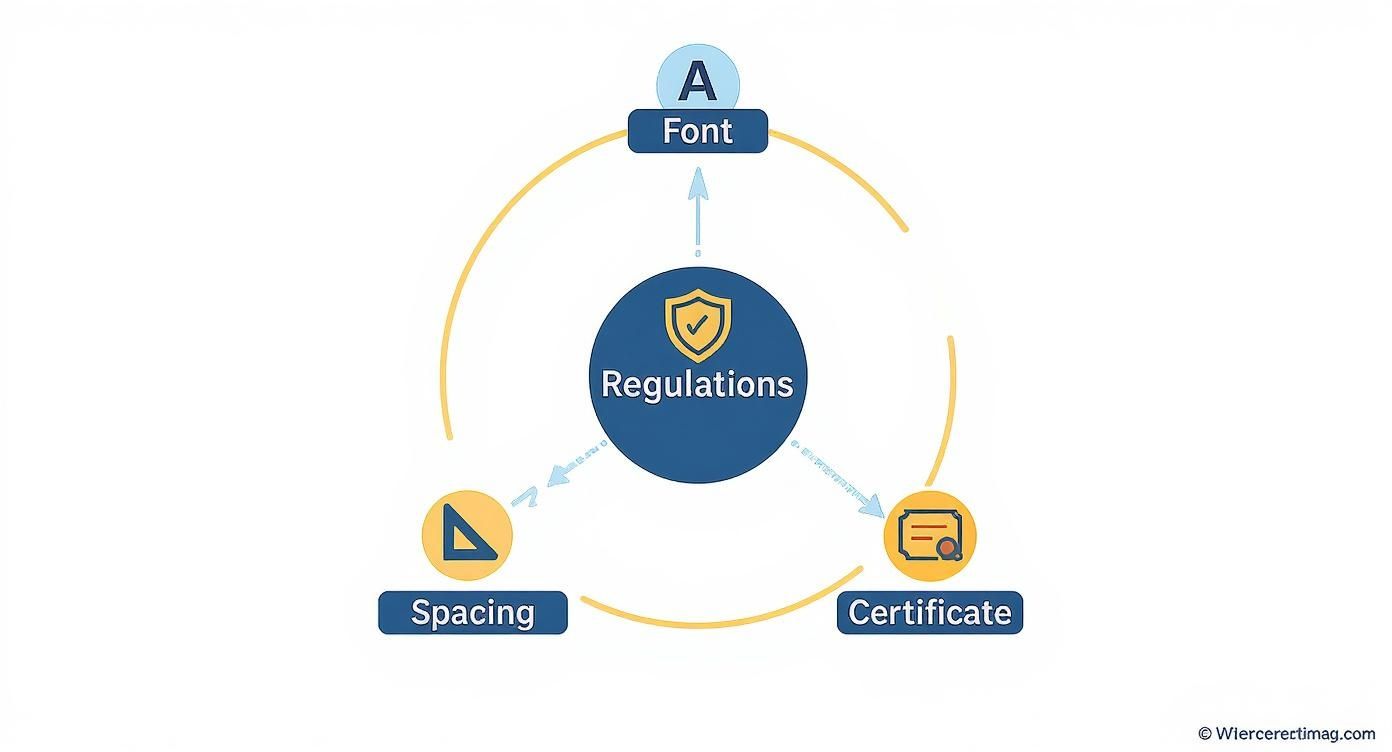
As you can see, getting it right isn't about ticking one box. It’s about ensuring all these foundational elements work together perfectly. Let’s break down exactly what that means.
The Mandated Charles Wright Font
First things first: the font. You can’t just pick one you like the look of. Every legal UK number plate must use the Charles Wright 2001 font. This isn’t a style choice; it’s a functional one. The font was specifically designed to be simple, clear, and uniform, making it incredibly easy for ANPR cameras to scan accurately at speed.
Standardising the font is a cornerstone of road safety and crime prevention. In fact, studies have shown that witnesses are better at recalling letters than numbers, and the UK's left-to-right format helps law enforcement piece things together. You can dive deeper into the fascinating history of GB number plates on number1plates.com.
This is precisely why you’ll never see road-legal plates with fancy script or stylised fonts. No matter how cool they look, they interfere with the plate's primary job: to be read without a shadow of a doubt.
Precise Character Sizing and Spacing
It’s not just the font style that’s set in stone; the dimensions and spacing of the characters are also meticulously defined. Getting these measurements wrong is one of the easiest ways to end up with an illegal plate.
Here’s the exact breakdown:
- Character Height: Must be 79mm tall.
- Character Width: Must be 50mm wide (the only exception is the number 1 or the letter I).
- Stroke Width: The thickness of the black lines making up the character must be 14mm.
- Space Between Characters: A gap of 11mm is mandatory between characters in the same group (e.g., between the 'A' and 'B' in 'AB24').
- Space Between Groups: A larger 33mm gap must separate the two main groups of characters (e.g., the space between '24' and 'CDE').
These numbers are completely non-negotiable. Even a few millimetres out can make the characters appear to blur together on camera, flagging your plate as illegal.
"The strict spacing rules are the most common area where vehicle owners fall foul of the law. Spacing is intentionally manipulated to make a plate appear to spell a name, but this is a guaranteed MOT failure and can result in a fine of up to £1,000."
The BS AU 145e Material Standard
The physical plate itself is just as regulated as the characters on it. Since 2021, all new number plates must meet the British Standard BS AU 145e. This standard dictates the plate’s durability and physical properties to make sure it can withstand the rigours of the road.
This updated standard is significantly tougher than its predecessor (BS AU 145d), introducing stricter tests for the materials used.
Key Requirements of BS AU 145e
- Durability: The plates have to be tough. They undergo abrasion testing to ensure they can resist damage from road debris, salt, and dirt that might otherwise obscure the registration.
- Retroreflectivity: Plates must be made from a material that reflects light, like a car’s headlights, straight back at the source. This is what makes them appear to "glow" at night, ensuring they are always visible.
- Supplier and Standard Markings: A legal plate must be permanently marked with two key pieces of information: the British Standard number (BS AU 145e) and the details of the registered supplier who made it (their name and postcode). You'll find these at the bottom centre and bottom right of the plate.
These markings are crucial. They create an audit trail, proving your plate was made by a legitimate, DVLA-registered business. If those markings are missing, your plate isn't road-legal. Simple as that.
Common Mistakes That Land You a Fine (or an MOT Fail)
Getting to grips with DVLA number plate rules can feel like a bit of a minefield, but the truth is, most trouble comes from a few common—and easily avoided—slip-ups. These mistakes, often made with the best of intentions to add a personal touch, can unfortunately lead to hefty fines, an instant MOT failure, and even the risk of having a cherished plate taken away.
Knowing where people go wrong is the best defence. It's like learning the rules of the game before you play; it saves a lot of hassle down the road.
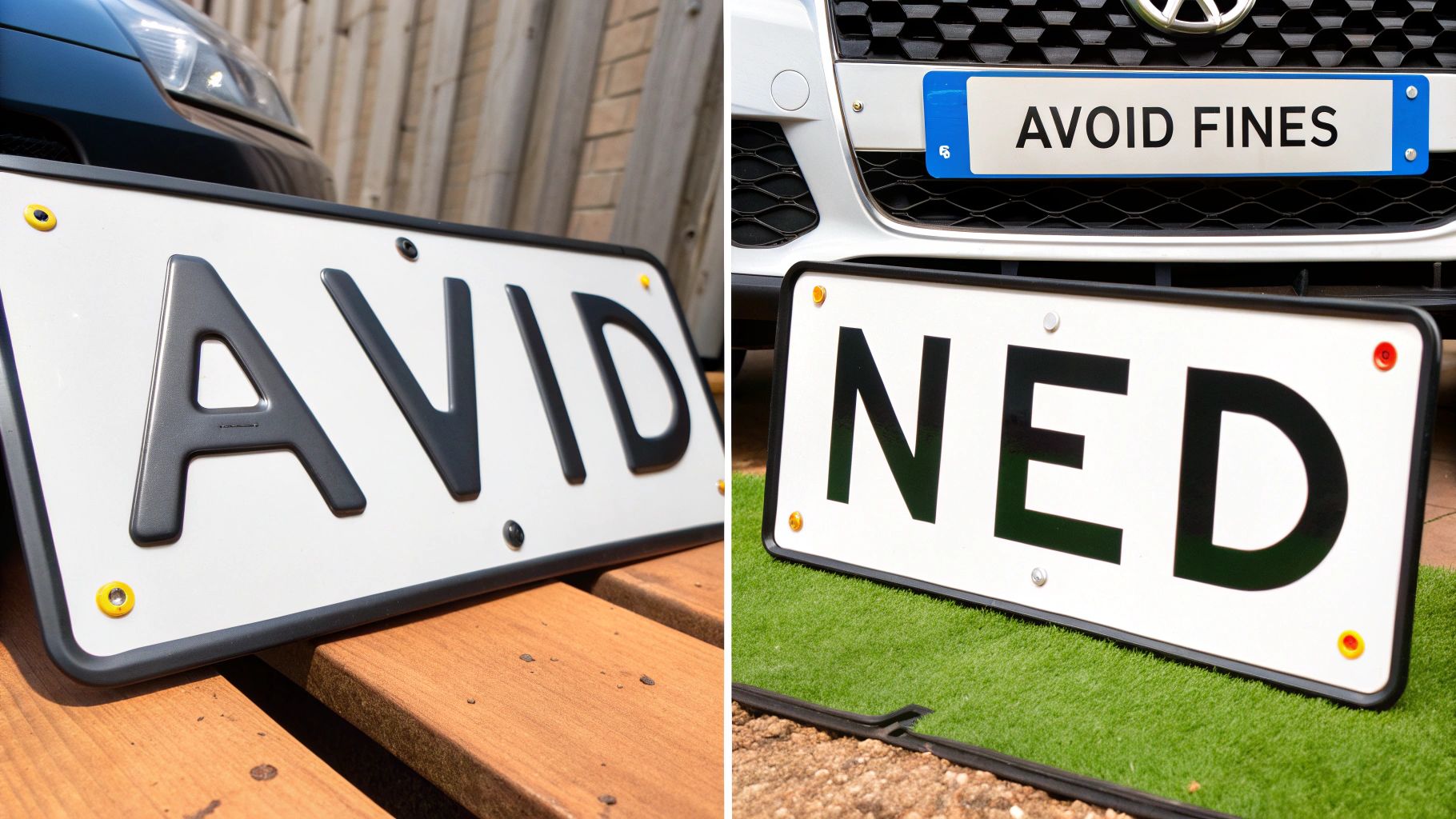
From "creative" fonts to a badly placed screw, let's break down the most frequent blunders that catch drivers out.
Incorrect Fonts and Spacing
This is, without a doubt, the number one reason people get into trouble. It’s incredibly common to see drivers tweak the spacing or use a fancy font to make their registration look like a name or a word. While it might seem clever, it’s a massive red flag for police ANPR cameras and a guaranteed MOT fail.
The law is crystal clear on this: only the standard 'Charles Wright' font is allowed. Any stylised, italic, or quirky fonts are strictly illegal. The same goes for spacing—that 11mm gap between characters and the 33mm gap separating the age identifier and the random letters must be precise. Deliberately bunching them up or spreading them out makes the plate non-compliant.
The whole point of a number plate is to be instantly readable by ANPR cameras. Altering the font or spacing messes with the system's ability to read it correctly, which undermines a critical tool for law enforcement.
Misplaced or Obscuring Fixing Bolts
Believe it or not, even how you attach the plate matters. Some people use screws with coloured or decorative caps, placing them strategically to change how a letter or number looks. A classic example is a black screw cap placed just so, turning a '0' into an '8' or an 'F' into an 'E'.
This is a big no-no. Any bolts or fixings have to be plain, non-reflective, and kept well clear of the characters. They can't interfere with the registration mark's readability in any way.
The Truth About 3D and 4D Plates
There’s a lot of confusion around 3D gel and 4D laser-cut plates. They're massively popular for giving a car a premium, modern finish. The good news? They can be 100% road legal, but only if they tick all the right boxes.
- Solid Black Characters: The raised characters themselves must be completely, solidly black. Any plates with two-tone effects, coloured outlines, or reflective bits on the letters are illegal.
- BS AU 145e Standard: They have to be made to the BS AU 145e standard. This ensures they have the correct reflectivity and durability and are marked with the supplier's name and the British Standard code.
- Correct Font and Spacing: Even with raised characters, the font must still be 'Charles Wright', and all the official spacing and sizing rules apply.
A 3D or 4D plate’s legality comes down to whether it meets these core requirements. If it's made by a registered supplier and follows the rules, you're good to go.
Illegal Flags and Logos
The rules allow for a few specific flags on the left-hand side—like the Union Flag or St George's Cross—and the green ZEV flash for electric vehicles. Anything else is banned. This includes:
- Football club badges
- Car manufacturer logos
- Cartoon characters
- Any other unapproved emblems or symbols
Sticking these on your plate makes it illegal for road use, no matter how professionally it’s done.
Missing Supplier Details
This is a sneaky one that catches a surprising number of people out: the missing supplier details and BS AU 145e mark. These tiny identifiers, usually printed at the very bottom of the plate, are a legal must-have. They prove the plate was made by a DVLA-registered supplier and meets all the required standards.
If you’re curious about this specific rule, you can find a detailed breakdown explaining why a supplier name and postcode are mandatory. Without those details, your plate simply isn't road legal.
Making Sense of Private and Personalised Plates
Getting a private or personalised number plate is a brilliant way to give your vehicle a bit of character. It could be a cherished registration passed down through the family, or maybe a new one that spells out your initials. Whatever the reason, it makes your car feel truly yours. But this personal touch comes with a clear set of DVLA rules that you absolutely have to follow.
These regulations aren't there to spoil the fun. They exist to protect the integrity of the vehicle registration system, ensuring every car on the road can be clearly and correctly identified. So, while the registration number might be personal to you, it’s still an official legal marker. That means even the most unique plate has to be displayed on a physical plate that meets all the standard requirements we've already covered—from the specific Charles Wright font to the BS AU 145e material standard.
There are no get-out clauses for private plates; they face the same tough scrutiny as any standard-issue registration during an MOT or a roadside police check.
The Golden Rule: Don't Misrepresent a Car's Age
When it comes to private plates, there's one rule that trumps all others. It’s simple, but it's not negotiable: you cannot use a registration number that makes a vehicle look newer than it actually is.
This rule is a crucial consumer protection measure. The age identifier—those two numbers in a modern registration—tells everyone the year the car was first put on the road. For instance, a '24' plate means the car is from 2024, and a '74' plate will signify a car registered in the latter half of 2024.
Let’s make this crystal clear with an example. Say you own a car that was first registered in 2021 (its original plate would have been a '21' or '71'). You’ve just bought a private plate with '24' as the age identifier.
- What you can do: You could put an older registration on your 2021 car. A dateless plate like 'ABC 123' or even a '19' plate is perfectly fine. This either makes the car's age unclear or makes it look older, which is completely legal.
- What you can't do: You are strictly forbidden from putting that new '24' plate on your 2021 car. Doing so would make it appear three years younger than it is, which is illegal.
Getting this wrong is a costly mistake. You could face a fine of up to £1,000, and worse, the DVLA has the power to confiscate your personalised registration number. You could lose your investment entirely.
Getting Your Plate on the Car: Assignment and Transfer
Once you've bought a private plate, it isn't automatically assigned to your vehicle. You need to follow an official DVLA process to link the two. This involves some key paperwork.
You’ll encounter two main documents:
- V750 Certificate of Entitlement: This is the pink form you get when you buy a brand-new, unassigned registration from the DVLA or a dealer. It’s your proof that you have the right to assign that number to a car.
- V778 Retention Document: This is the green form. You get this if you take a private plate off a vehicle to keep it for later. It effectively puts the registration on hold until you’re ready to use it again.
Thankfully, the process of assigning or transferring a plate is now mostly done online through the DVLA website, and it’s usually instant.
A common pitfall is thinking that just because you have the certificate, you can slap the plate on any car. The age rule is absolute. Always double-check your vehicle's first registration date on your V5C logbook before you even think about assigning a newer plate.
The Business of DVLA Auctions
The world of private plates is big business. The DVLA cottoned on to this years ago and, since launching its first personalised registration auctions in December 1989, has turned them into a huge source of income. This move has generated over £2 billion for the UK treasury, with some plates becoming incredibly valuable assets. You can find out more about the fascinating history of UK number plates on sandhurstautoprint.co.uk.
The DVLA now holds several official auctions each year, selling off thousands of registrations that have never been issued before. These events are a magnet for collectors, investors, and enthusiasts, with some plates selling for tens or even hundreds of thousands of pounds.
But at the end of the day, it doesn't matter if your plate is a six-figure investment or a simple gift. The rules are the same for everyone. It must be displayed on a legally manufactured plate that meets every single DVLA standard to be road legal.
Getting to Grips with Flags, Emblems, and Green Flashes
Once you've nailed the basics of characters and spacing, you might want to add a bit of personality to your number plate with an optional identifier. But this is where you need to tread carefully. The DVLA's rules on what you can and can't display are incredibly specific and leave no room for interpretation.
Think of it this way: your number plate has a job to do – to be instantly readable. Any unapproved symbols, no matter how small or seemingly harmless, get in the way of that. Let’s walk through the only additions that will keep you on the right side of the law: national flags and the green flash for electric vehicles.
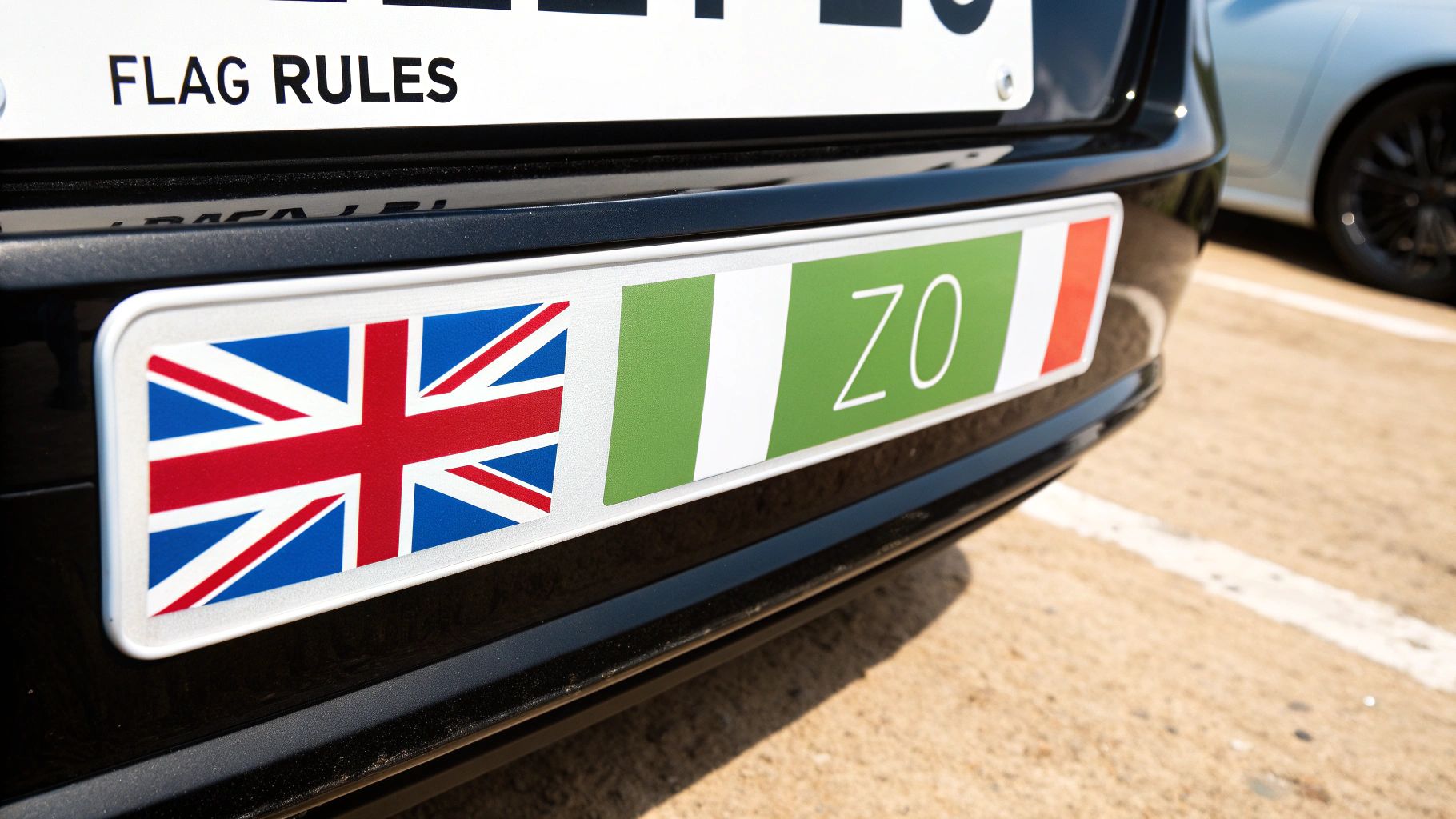
Flying the Flag: What’s Legal?
It's common to want to show a bit of national pride, and the rules do allow for a national flag on the far-left side of the plate. This is the only spot it can go, usually inside a blue band. However, only a handful of specific flags and their matching letter codes are permitted.
Here’s the complete, official list of what you can choose:
Permitted National Flags and Identifiers
This table breaks down exactly which flags can be legally paired with which letter codes. Mixing and matching is not allowed.
| Flag/Symbol | Permitted Letter Identifier(s) | Notes |
|---|---|---|
| Union Flag | UK | Must be used with the "UK" identifier. |
| Cross of St George | ENG | Must be used with the "ENG" identifier. |
| Scottish Saltire | SCO | Must be used with the "SCO" identifier. |
| Red Dragon of Wales | CYM | Must be used with the "CYM" identifier. |
The key takeaway is that the flag and letters are a package deal. You can't, for instance, display the Union Flag with the letters "ENG". The letters must also be in capitals and sit above the flag itself. Any other combination is an instant fail.
One of the most common pitfalls we see is people assuming any flag or emblem is fair game. The regulations are black and white on this: sports team logos, brand badges, or any other unlisted flag will get you an MOT failure and a potential fine.
The Green Flash: A Badge for Zero-Emission Vehicles
Back in 2020, a new feature was introduced: the green flash. It's a vertical green stripe on the far-left side of the plate, designed to make zero-emission vehicles (ZEVs) easy to spot. This is strictly for vehicles that produce zero CO2 emissions at the tailpipe, which means it’s only for fully electric cars and vans. Hybrids don't qualify.
Having this green marker is completely optional. If you own an EV, you don't have to display it. However, it can be a handy visual cue for local authorities, potentially unlocking perks like free entry into Clean Air Zones or access to special EV parking bays.
What's Strictly Off-Limits?
Knowing what not to do is just as important for staying compliant. The rules are clear: no symbols, logos, or emblems other than the officially permitted ones are allowed on a road-legal plate.
This means all of the following are illegal additions:
- Football club crests or other sports logos.
- Car manufacturer badges (like a Ford or Audi logo).
- Religious symbols of any kind.
- Cartoon characters or other fun images.
- Social media handles or business website addresses.
Adding any of these will immediately render your number plate illegal. The only way to be certain you're compliant is to stick to the officially approved flags or the green ZEV flash.
Your Practical Checklist for DVLA Compliance
Knowing the DVLA's rulebook is one thing, but making sure your own plates tick all the right boxes is what really counts. We've boiled it all down into a simple checklist to help you spot any potential problems before they find you.
This isn't just about dodging fines. It's about being confident your car is road-legal, ready for its next MOT, and won't give anyone a reason to pull you over. Think of it as a quick MOT for your plates.
Your Five-Point Plate Check
Grab your car keys and let's take a closer look at your front and rear plates. A quick once-over with these five questions will tell you if you're on the right side of the law.
- Is the Font Correct? Look closely at the letters and numbers. They need to be the standard ‘Charles Wright 2001’ font. It’s a very plain, clear font with no extra bits or stylistic flair.
- Is the Spacing Legal? Get a ruler out if you have to. The key thing to check is the larger 33mm gap between the age identifier (like '24') and the three random letters that follow. Any custom spacing, often used to make a plate spell a name, is a definite no-go.
- Are the Markings Present? Scan along the bottom edge of the plate. You should find the name and postcode of the supplier who made it, plus the all-important BS AU 145e mark. If those aren't there, your plate isn't compliant.
- Are the Materials Correct? The background has to be retroreflective—that means a white plate at the front and a yellow one at the back. The characters themselves must be solid black and non-reflective, even if you have 3D or 4D style plates.
- Are There Any Illegal Additions? Take a final look. Is there anything on the plate besides an approved national flag or the green ZEV flash for electric vehicles? Any other logos, symbols, or slogans will instantly make it illegal.
A compliant number plate is your vehicle's passport on the road. Just like a real passport, every detail must be correct and officially verified. Any deviation, no matter how small, can render it invalid in the eyes of the law.
Running through this quick check is the easiest way to catch the most common plate issues. And remember, when you order new plates, any registered supplier has to ask for documents to prove who you are and that you have the right to use the registration. You can find a full rundown of the required documents for road-legal number plates to make sure you're ready. This is a crucial step that keeps illegal plates off our roads.
Got Questions About DVLA Rules? We've Got Answers
Even when you think you’ve got a handle on the rules, tricky situations can pop up. It’s always best to be sure. To help you stay on the right side of the law, we've tackled some of the most common questions drivers ask about UK number plates.
From the truth about modern plate styles to the real-world consequences of getting it wrong, here are the straight answers you need.
Are 3D and 4D Number Plates Actually Legal?
Yes, they absolutely are. Both 3D gel and 4D laser-cut plates are perfectly legal for UK roads, but there’s a crucial catch: they must meet the BS AU 145e standard. This is the non-negotiable part.
For a 3D or 4D plate to be compliant, the characters have to be solid black and non-reflective. They also need to be in the mandatory 'Charles Wright' font, with all the correct sizing and spacing. Any legitimate plate will be marked with the supplier's name and the BS AU 145e code. If you see plates with coloured layers under the black, reflective characters, or any other effect that could confuse an ANPR camera, they are illegal for road use.
It's a common myth that any plate with raised letters is automatically a "show plate." The truth is, as long as it’s made by a registered supplier and ticks all the boxes of the BS AU 145e standard, it’s 100% road-legal.
What Happens if I Get Caught With an Illegal Number Plate?
Displaying a non-compliant plate isn't just a slap on the wrist. The penalties are serious and designed to make you think twice.
You're looking at a potential fine of up to £1,000, and your car will fail its MOT on the spot. Police can also issue a Fixed Penalty Notice right there at the roadside. Worse still, if the illegal plate is showing a private registration, the DVLA has the power to take that number away from you for good. That means you could lose the money you invested in it, with no chance of getting it back.
What Should I Do if My Plates Are Stolen?
Discovering your plates have been stolen is a real worry, and you need to act fast. First thing’s first: report it to the police immediately and get a crime reference number. This is essential because criminals use stolen plates for everything from driving away from petrol stations without paying to racking up speeding tickets and dodging congestion charges.
Once you've spoken to the police, you need to tell the DVLA. This is a critical step to ensure you aren't held responsible for any offences committed using your car's identity. With that sorted, you can order a new set of plates from a DVLA-registered supplier. Just remember to have your V5C logbook and a form of ID ready, as they'll need to see them before making your new, legal plates.
Ready to get a fresh set of fully compliant plates for your vehicle? As a DVLA-registered supplier, Limitless Plates provides premium 3D, 4D, and standard number plates that are 100% road-legal and meet the strict BS AU 145e standard. You can design your perfect, compliant plates online today.
Article created using Outrank


