
If you’ve ever wondered about the official UK number plate size, you're not alone. The one you’ll see most often is 520mm x 111mm, but that's not the full story. The final size of a legal number plate is actually dictated by a strict set of rules for the characters, spacing, and margins—not one single, mandatory measurement.
Why There’s No Single UK Legal Number Plate Size
Many drivers assume there's one government-mandated size for all car number plates, but the law is actually far more flexible. It doesn't specify a fixed plate dimension. Instead, it lays down the exact measurements for everything on the plate. Think of it like building with Lego: the size of your final creation depends entirely on the size of the individual bricks and how you connect them.
The familiar 520mm x 111mm plate is simply the most common because it perfectly fits a standard seven-character registration while following all the spacing and margin rules set out by the DVLA.
The Real Rules Dictating Plate Size
The true determinant of a legal number plate’s size comes down to these fundamental building blocks:
- Character Dimensions: Every letter and number (except for '1' or 'I') must be precisely 79mm tall and 50mm wide.
- Spacing Rules: There must be an 11mm gap between each character. The central space separating the age identifier from the random letters needs to be a wider 33mm.
- Mandatory Margins: A clear, reflective border of 11mm has to surround the entire registration mark.
When you add all these precise measurements together for a typical registration, you naturally land on that well-known 520mm x 111mm rectangle. This is why if your registration has fewer characters, you can legally opt for a shorter plate, as long as you maintain that crucial 11mm margin all the way around.
This focus on legibility over fixed dimensions isn't just a modern quirk. The system of standardised vehicle identification has been evolving for over a century to ensure every plate is clear and uniform on our roads.
A Long History of Regulation
The legal framework for number plates isn't new; it dates right back to the start of the 20th century. The system was first established by the Motor Car Act of 1903, which made it compulsory for all vehicles to display alphanumeric plates from 1st January 1904, to guarantee consistent identification. You can dive deeper into the evolution of these regulations on Wikipedia.
This long history shows why the primary goal has always been readability. The current rules are simply the modern version of a century-old objective: making sure every vehicle can be easily and accurately identified, whether by the human eye or an ANPR camera. That’s why getting the character and spacing rules right is far more important than the overall size of the plate itself.
What Goes Into a Legal Number Plate?
Think of a legal number plate less as a single, fixed object and more like a precisely assembled puzzle. While the final size can differ, the individual pieces—the characters, spaces, and margins—have strictly defined dimensions. It’s the sum of these parts that determines the overall size of the plate. Honestly, getting these tiny details wrong is the number one reason a plate fails an MOT.
The starting point for any compliant plate is the font. The law is crystal clear: every plate must use the Charles Wright font, introduced back in 2001. It was designed specifically to be easy to read, both for people and for the ANPR cameras that are everywhere now.
This diagram shows how all those little elements come together.
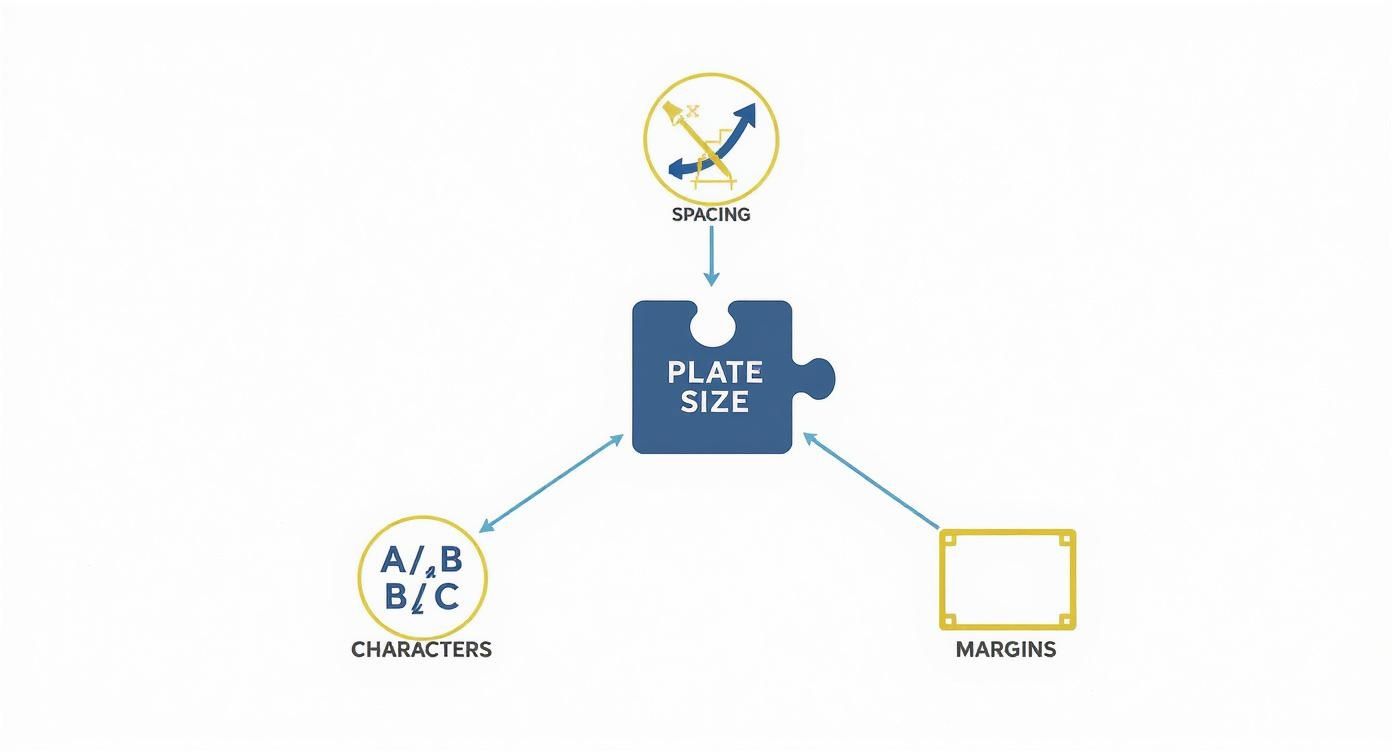
As you can see, it's not about one single measurement. It's the combination of the characters, the gaps between them, and the border around the edge that dictates the final, legal size.
The Nitty-Gritty: Character and Spacing Rules
The DVLA rules are incredibly specific, right down to the millimetre. Every standard character (that's any letter or number except for '1' or 'I') must be precisely 79mm high and 50mm wide. The thickness of the character stroke itself has to be 14mm. This isn't just for looks; it’s essential for the automated camera systems that monitor our roads.
The empty space is just as important as the characters. The spacing rules are non-negotiable and have to be perfect.
- Between Characters: There must be an 11mm gap between each character in the same group (for example, between the 'A' and 'B' in AB24).
- Between Groups: A much larger gap of 33mm is required to separate the age identifier from the first and last set of letters.
- Plate Margins: A clear border of at least 11mm must be present around the entire registration mark—top, bottom, and both sides.
That 11mm margin is the key to legally shorter plates. If you have a private registration with fewer than seven characters, the physical plate can be smaller, but only if that crucial 11mm border is kept intact all the way around.
Messing up these measurements isn’t a minor issue. It can result in a failed MOT or even a fine of up to £1,000. These rules aren't just guidelines; they're the law. For a complete rundown, our guide to DVLA number plate regulations has all the details. Rest assured, every plate we make at Limitless Plates is built to these exact standards, keeping you fully compliant and on the right side of the law.
How Plate Size Changes for Different Vehicles

While the standard 520mm x 111mm plate is the most common sight on UK roads, it's certainly not a one-size-fits-all solution. The DVLA understands that what works for a family saloon would look ridiculous, and frankly be unsafe, on the back of a motorcycle. That's why the rules are designed with built-in flexibility.
This adaptability is key. The regulations ensure every plate is clear and legible without forcing a cumbersome piece of plastic onto a vehicle where it just doesn't belong. Let's look at a few common examples.
Motorcycles and Motor Tricycles
Motorcycles are the most obvious exception to the standard single-line plate. Their slim profile at the back just doesn't have the space for a wide, rectangular car plate. It would be completely impractical.
Because of this, any motorcycle or motor tricycle registered on or after 1st September 2001 must display its registration over two lines. This is only required on a rear plate, as bikes aren't required to have one on the front.
The two-line format is a clever solution. It allows the characters to remain a legally legible size, making them easy for other drivers and ANPR cameras to read, all within the limited space available on the back of a bike.
This setup ensures the uk legal number plate size is perfectly suited to the vehicle while still following all the crucial character and spacing rules.
Imported Vehicles and Unique Shapes
Another common reason for non-standard plates is imported vehicles. Cars brought in from places like the US or Japan often have smaller, squarer recesses designed for their own domestic plates. Trying to fit a standard UK plate into one of these can look awkward at best, and be impossible at worst.
Thankfully, the DVLA allows for alternative plate sizes to accommodate these vehicles, but there are some non-negotiable rules that still apply:
- Font and Spacing: The plate must use the mandatory Charles Wright font with the correct spacing between characters.
- Margins: That critical 11mm border around the entire registration mark must be present.
- BSAU 145e Standard: The plate itself must be manufactured to the current British Standard.
This means you can get a fully legal, smaller plate that fits your import's recess perfectly, keeping the car looking as the designers intended. At Limitless Plates, creating bespoke plates for unique vehicles is our specialty. We can craft plates in custom sizes that tick every legal box.
For those with shorter registrations, you can find more information in our guide to short number plates, which are a great, fully road-legal option. It's all about making sure your car looks its best while staying completely on the right side of the law.
Here’s a quick breakdown of how plate sizes vary across different types of vehicles you'll see on UK roads.
Plate Size Requirements for Different UK Vehicles
| Vehicle Type | Common Plate Dimensions | Key Considerations |
|---|---|---|
| Standard Cars | 520mm x 111mm | The most common size, suitable for the majority of UK-spec cars and vans. |
| Motorcycles & Tricycles | 228mm x 178mm (Varies) | Must be displayed over two lines on the rear of the vehicle only. |
| Imported Vehicles | Varies (e.g., 305mm x 152mm for US) | Can use non-standard sizes to fit the vehicle's recess, but must adhere to all font, spacing, and margin rules. |
| Large Goods Vehicles (LGVs) | 520mm x 111mm | Typically use the standard car size, but split rear plates are common on some trailer configurations. |
This table shows just how much the rules can adapt. The goal is always the same: ensuring the registration is clearly visible and meets legal standards, regardless of the vehicle's shape or size.
What the BSAU 145e Stamp Really Means
If you look closely at any legally made number plate, you’ll spot a small code tucked away on it: BSAU 145e. This isn't just a jumble of letters and numbers; it’s the official seal of approval for every legal UK number plate. Think of it as a stamp of quality and resilience, proving the plate is built for British roads.
This little mark is your guarantee that the plate is far more than just a piece of plastic with some letters stuck on. It certifies that the materials used are tough enough to handle the rigours of everyday driving – from resisting impacts from flying stones to standing up against corrosion from winter road salt and preventing fading under the summer sun.
Decoding the Standard
The BSAU 145e standard is the latest version of the British Standard for number plates, which came into force in 2021. The 'e' at the end signals this most recent update, introducing even tougher tests than the old BSAU 145d version. It's a comprehensive benchmark that covers every critical aspect of a plate's quality.
The standard ensures your plate meets strict requirements for:
- Durability: It must survive a gauntlet of tests, including for abrasion, bending, and impact. In simple terms, it won't snap, crack, or get bent out of shape easily.
- Reflectivity: The plate has to meet specific reflective properties. This is vital for ensuring it can be read clearly by ANPR (Automatic Number Plate Recognition) cameras day or night, rain or shine.
- Character Legibility: The letters and numbers must be printed in a single shade of solid black. This rules out any two-tone or 3D-effect fonts that could confuse enforcement cameras.
In essence, the BSAU 145e stamp is your assurance that the plate is built to last and will function exactly as it should within the UK’s road monitoring network. It’s a promise of both quality and compliance.
Why This Matters for You
Knowing what this code means shows that a legal plate is about so much more than just the right uk legal number plate size and font. It's a crucial piece of vehicle identification and road safety equipment.
A cheap, unstamped plate from an unregistered seller will almost certainly not meet these standards. That means it could be brittle, fade quickly, and become unreadable to ANPR cameras, which could lead to a failed MOT or even a hefty fine.
Here at Limitless Plates, we are a DVLA registered supplier. Every single road-legal plate we make is manufactured to the exacting BSAU 145e standard. This guarantees your new plates aren't just a great-looking upgrade, but are also fully compliant, tough as nails, and ready for whatever the road throws at them.
Avoiding Common Number Plate Mistakes
Navigating the rules for UK number plates can feel like a minefield, but keeping your car legal is actually pretty simple once you know the common traps. All too often, drivers get tripped up by simple errors, turning what they thought was a cool customisation into a very expensive problem. We're not just talking about a failed MOT; you could be facing a £1,000 fine.
The number one mistake we see? Incorrect spacing. It's so tempting to nudge characters together to make a plate look like a name or a word, but that’s a guaranteed fail. The mandatory 33mm gap between the age identifier and the three random letters is non-negotiable. This isn’t just red tape; it's essential for ANPR cameras to read your plate accurately every time. For a deeper dive, check out our guide on correct number plate spacing.
Key Errors That Invalidate Your Plate
Beyond spacing, there are a few other pitfalls that can make your number plate illegal. Knowing what they are is the best way to stay on the right side of the law.
- Non-Standard Fonts: The only font allowed is the 'Charles Wright' font. Any fancy, italicised, or custom fonts might look good, but they're a fast track to failing your MOT and getting pulled over.
- Illegal Badges and Logos: You can have national identifiers like the Union Jack or the Welsh Dragon on the left-hand side, but that’s it. Sticking your favourite football team's crest or any other unofficial symbol on there is strictly forbidden.
- Tinted Covers: Any cover, spray, or film that dims the plate's reflectivity or makes the characters harder to see is illegal. The law states your plate must be clearly visible from 20 metres away, day or night.
- Strategically Placed Screws: This is an old trick, but the authorities are wise to it. Using screw caps or bolts to cleverly alter a letter or number (like making an ‘8’ look like a ‘B’) is a serious offence.
It helps to think of a number plate as your car's official ID card. Anything you do to make it harder to read is seen as a deliberate attempt to hide your vehicle's identity, which is why the penalties can be so harsh.
Staying Compliant with Standardisation
These rules didn't just appear overnight; they've grown with the number of cars on our roads. The big change came in 2001, when the current system was introduced to standardise the size, font, and layout. With over 37 million vehicles in the UK, this consistency is vital for digital enforcement systems to work properly.
Here at Limitless Plates, we take this very seriously. Every single plate we make is produced in strict compliance with these standards. When you buy from a registered supplier like us, you get peace of mind knowing your plate is fully road-legal, saving you from fines and hassle down the line.
Your UK Number Plate Questions Answered
Even when you think you know the rules, certain situations can still leave you scratching your head. Let's tackle some of the most common questions drivers have about UK number plate sizes, styles, and regulations. We’ll give you clear, straightforward answers so you can drive with complete confidence.
Can I Use a Shorter Plate for a 5 or 6 Digit Registration?
Absolutely. This is probably one of the most frequent questions we get. Shorter plates are completely legal for registrations with fewer than seven characters, but they come with one crucial condition.
The plate must still have a minimum 11mm margin of blank, reflective space around the entire registration mark. This simple rule is what allows the plate’s overall length to be trimmed down without making the characters harder to read. But you can't just take a pair of scissors to a standard plate. A legally compliant short plate has to be made by a registered supplier, and it must clearly show the BSAU 145e mark and the supplier’s details to be road-legal.
Are 3D Gel and 4D Laser-Cut Plates Legal?
Yes, they are. Both 3D gel and 4D laser-cut plates are legal here in the UK, as long as they stick to the DVLA's strict standards. The critical point is that the characters themselves must be solid black; it's their raised physical profile that is permitted.
Where people get into trouble is when they add visual effects like highlighting, shadowing, or two-tone colouring. These additions can confuse ANPR cameras, which makes the plates illegal.
To stay on the right side of the law, any stylised plate must:
- Use the mandatory Charles Wright font.
- Meet all official character size and spacing requirements.
- Be manufactured to the BSAU 145e standard by a DVLA-registered supplier.
At Limitless Plates, our 3D and 4D options are designed to meet these exact specifications, offering a premium look that is fully road-legal and MOT-compliant.
What Are the Rules for a Green Flash on EV Number Plates?
The green flash is an optional feature designed specifically for zero-emission vehicles, like fully electric cars. Think of it as a quick visual signal to show that the vehicle produces no tailpipe emissions.
For the flash to be legal, it has to be a very specific shade of green (Pantone 7481c) and can only be positioned on the far left-hand side of both the front and rear plates. It’s also important to know that you can't just add a green sticker to an old plate. The flash must be integrated into a brand-new plate made by a registered supplier. Petrol, diesel, and even hybrid vehicles are not allowed to display one.
How Can I Tell if a Number Plate Supplier Is Legal?
This is perhaps the most important question of all. Buying from an unregistered seller is the fastest way to end up with an illegal plate and a potential fine. Fortunately, a few simple checks will tell you if a supplier is legitimate.
First, just look at the plate itself. A legal plate must show two key bits of information:
- The Supplier's Details: The supplier's name and postcode have to be printed at the bottom centre of the plate.
- The British Standard Mark: The code ‘BSAU 145e’ must be visible at the bottom right.
Second, pay attention to the buying process. A registered supplier is legally required to see original documents proving who you are (like a driving licence) and that you have the right to use the registration number (like the V5C logbook). If a seller doesn’t ask for this proof, they are operating illegally, and you should walk away. It's a system designed to protect everyone.
Choosing a compliant supplier ensures your plates don't just look good, but also fully adhere to the necessary uk legal number plate size and quality standards, keeping you on the right side of the law.
At Limitless Plates, we are a DVLA-registered supplier committed to quality and compliance. Every plate we create, from standard replacements to custom 3D and 4D styles, is manufactured to the strict BSAU 145e standard, ensuring it is 100% road-legal. Design your perfect, compliant plates today.
Article created using Outrank


